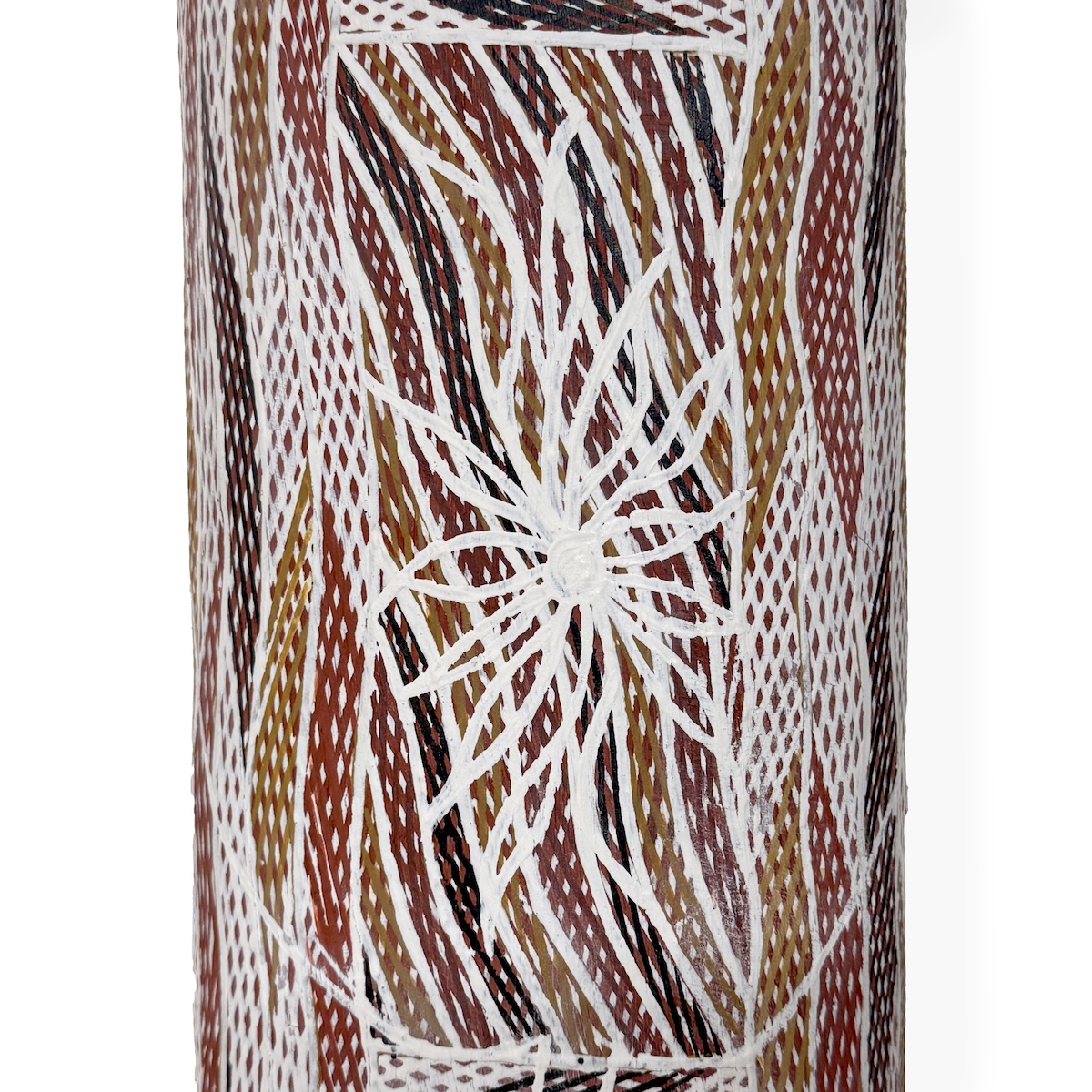
Lulumu
$4,310.00

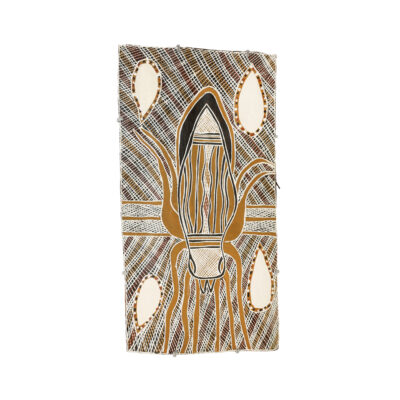
After the disruption of the early contact era the Madarrpa returned from Numbulwar to live permanently at Bäniyala, clan land north on Blue Mud Bay under the direction of clan leader and father to the artist, Wakuthi in the early 1970s.The Madarrpa always had Ancestral connection to this land – no dispute. Their grandfathers are buried under the sacred ground there. The setting up of an outstation at Bäniyala was part of the initial push back to the homelands from the intolerable intrusion of large scale mining that had surrounded Yirrkala community (formally mission) from the early seventies. There are hugely significant stories out of this country for the Yirritja, (some of which are shared with the Dhalwaŋu and Maŋgalili clans) that deal with law and ritual. The sacred design of the waters shared by these clans is shared also. Other stories, perhaps no less significant deal with creation or more recently fabled events. This land is formed through the story of Lulumu the cowtail ray of Yilpara legend. Gurrtjpi (cowtail ray) are stingray hunted much on the shallow shores of Blue Mud Bay. It is also a totem for the Madarrpa at Bäniyala as they talk of Gurrtjpi having a path of creation at Bäniyala. A few hundred yards down the beach at Bäniyala, a small tidal creek cuts through the dunes to the flat country immediately behind. This small creek named Mäwaŋga was used by Gurrtjpi to track back into the bush. Here he bit into the ground forming several small billabongs, a source of water for Yolŋu living there. His path continued along the direction that is now the Bäniyala air strip to flat sandy country before heading out to the point Lulumu to become a white rock surrounded by the slow tides. During the days of Woŋgu the Djapu warrior (1930s), an area in the shape of the stingray was cleared by him and others who came to country to hunt Gurrtjpi mid way through the dry season. The sculpture is still clear today, his two eyes holes in the ground where the current inhabitants pick sand to throw in the direction of the rock at Lulumu for good luck and plentiful fishing.
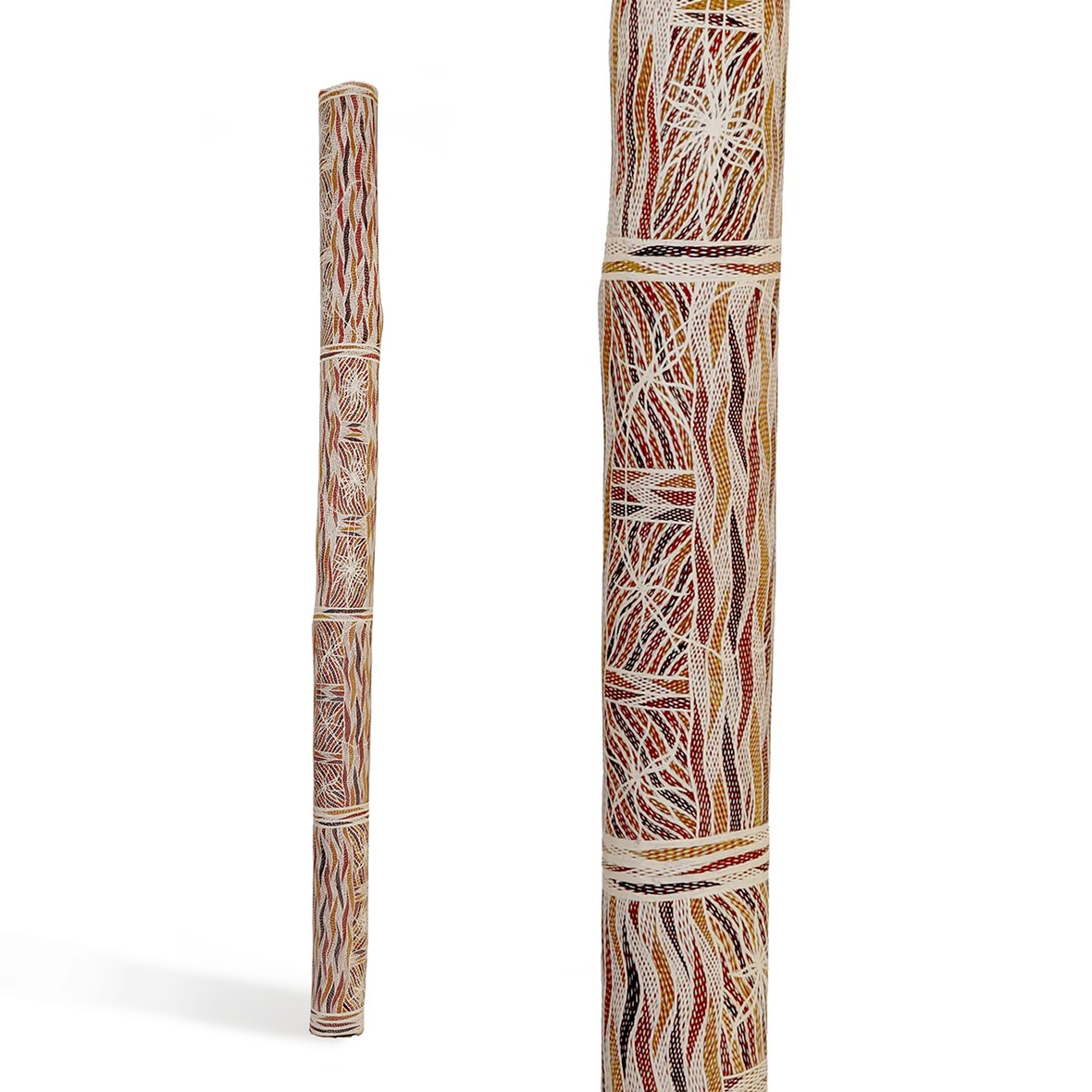
The Larrakitj has often been referred to as the mother’s womb. Once sedentary mission communities were established in Arnhem Land it became impractical to abandon permanent communities and outlawed to expose corpses on platforms. However the cosmology of the Yolŋu and the essence of ritual mortuary ceremony remains just as important. Larrakitj continue to be produced as the equivalent of headstones or to contain the personal effects of a deceased (which might be dangerous unless removed from the living because of the emanations imbued by contact with the deceased).
A further role for this cultural form is as a fine art object and an instructional tool for younger generations. Artworks of this nature have multiple layers of metaphor and meaning which give lessons about the connections between an individual and specific pieces of country (both land and sea), as well as the connections between various clans but also explaining the forces that act upon and within the environment and the mechanics of a spirit’s path through existence. The knowledge referred to by this imagery deepens in complexity and secrecy as a person progresses through a life long learning process.
Available
Price includes shipping within Australia, please contact us for international shipping.